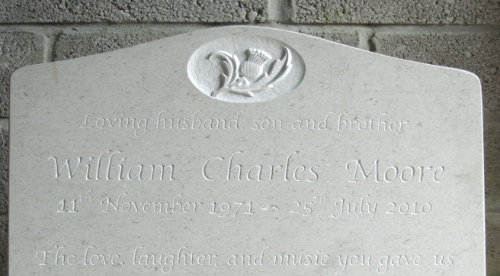
Here’s an article Simon wrote for the magazine of the Churches Conservation Trust, Pinnacle.
A former boss from Brighton once told me about the times when his grandfather owned the yard.
If a headstone in Lewes (about 12 miles away) needed the addition of a spouse inscribed, the man equipped with hammer and chisels went by bicycle to the church. With the aid of a few scratched lines and marks, he set out the words and started cutting. All this took time, and often the man would come to the end of the day before the end of the task.
He would be given money to have a meal and pint at a nearby pub, and pass the evening there. But though the grandfather was said to be a good boss, his generosity had limits, and accommodation’ WAS’ unpaid. The mason would often spend the night under a tarp thrown over a couple of headstones, and finish the job in the morning.
Though I have yet to spend the night in a graveyard, I know how easy it is to lose yourself wandering amongst the headstones, musing at all those past lives. Our fascination with the celebrated and famous, our wonder at the ancient; all of human diversity suspended at arms length, reduced in epitaph to just name, birth, death, and a few words of remembrance. Those parting words give us a glimpse into a person’s life, and often touch us deepest.
Starting every day by confronting death at the end of your chisel makes for difficult work. As a mason you try to be concerned more with the craft than the sentiment of the words.
There is always work of course, and it is exacting and challenging and varied. Apart from the shaping of the stone, and the carving details, you can create letters in many ways; incised either chased or stabbed, raised with the background in relief, filled with lead, and — most commonly today — ground or sand- blasted.
The hand cut, chased letter (so called as you work the chisel along the letter), derived from Roman (Trajan) script, offers a gorgeous and precise finish. One key exponent being Eric Gill. The commercial hand cut letter however, is generally stabbed, where the straights are chopped first (the length of straight determining the width of chisel), then joined by chasing in the rounds.
l’ve seen this technique conducted at terrific pace. The mason in question was a travelling man, and journeyed from Belgium by truck, arriving at the yard late in the day, where about a dozen stones to be set aside for him. As a young man, I watched in awe as this curious character, scruffy and reeking of cannabis, outlined the 200 or so letters, on the first stone, with just a handful of marks and set about the cutting. With a succession of rapid strikes from his hammer, and his chisel swinging left and right, he cut either side of the ‘V’ incision, quickly changing chisels every so often. The spoil fell away, and his hands swept across the surface to reveal the words.
A need to mark our existence somehow, either by offspring, or achievement, or headstone seems ubiquitous. Remembrance being an extension of our fleeting lives.
Amongst some of the most fleeting perhaps are the 1.7 million lives remembered by the Commonwealth War Graves Commission (CWGC). Formed in 1917 (as the Imperial War Graves Commission), to provide permanent memorials to the fallen and the lost, unknown, but not forgotten dead, with no distinction based on rank, race or faith. The order and repetition are in stark contrast to most graveyards. Clean lines of clean stone replace the natural disarray common in churchyards. The unnatural lack of ageing reflects perhaps the unnatural passing of so many young service men and women.
A visual and haunting display of the vast numbers killed in battle conceived by designers such as Sir Reginald Bloomfield (Menin Gate, Ypres] and Sir Edwin Lutyens, with Rudyard Kipling assigned as literary advisor to recommend inscriptions. The CWGC’s vision is to, “fulfil the function they [the memorials] were designed for, and understanding, maintaining and preserving the wider significance they have.” To maintain such a presence requires a huge commitment. Entering their second century many of the monuments have suffered.
Weather and pollution cause damage to stone, so a process of repair and replacement is necessary to combat the ravages of time. It is CWGC policy to maintain the legibility of inscriptions and prevent the loss of such valued information. Each year, tens of thousands of re-engravings are carried out by hand, as even words written in stone eventually fade. The masons erect small tents over the headstones and set about re-defining the lettering. Though whether overnight accommodation is provided, is unclear.
In my local churchyard Lichens creep, and crosses stretch their wilting arms at days end. An ancient yew once more casts shade over a decaying headstone in their daily play. Which will outlast the other I wonder.